
SINTA 4 ACCREDITED
OPEN ACCESS
BLIND REVIEW
Journal of Islamic Contemporary Accounting and Business
The Journal of Islamic Contemporary Accounting and Business is published by the Sharia Accounting program at the Tazkia University.
Popular:
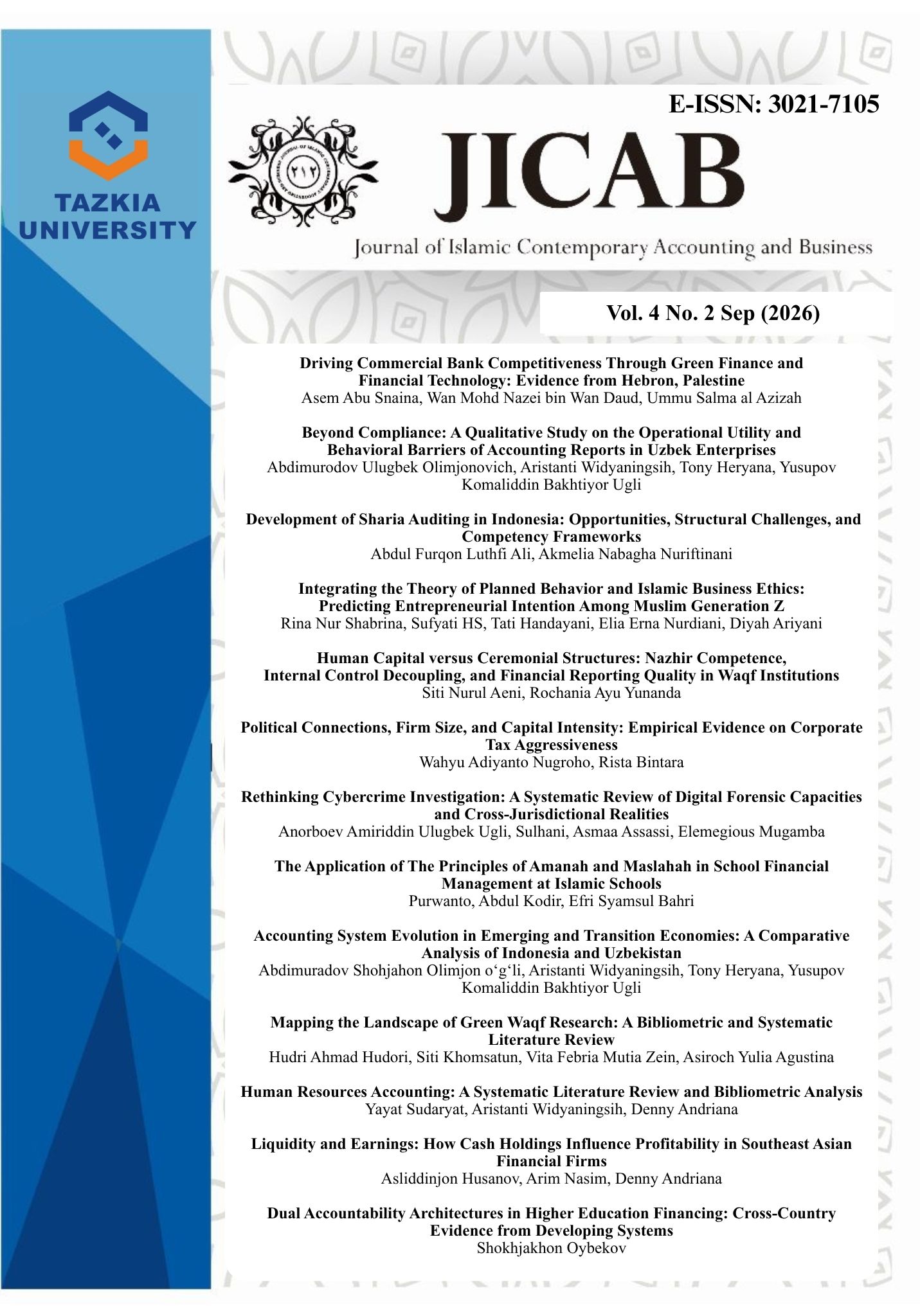
Current Issue
Vol. 4 No. 2 (2026): JICAB
Published: 2026-09-22
Algeria
Indonesia
Malaysia
Palestine, State of
Spain
Uzbekistan
Current Issue · 13
13
papers in the current issue
6
author countries
19
institutions represented
2×
issues a year
INDEXED BY
CURRENT ISSUE · Vol. 4 No. 2 (2026): JICAB
Articles





In this issue, JICAB features 13 papers in a single publication for the first time. The authors in this edition hail from six different countries—Palestine, Malaysia, Spain, Algeria, Uzbekistan, and Indonesia—representing 16 distinct institutions. The topics featured in this issue encompass green finance, the usefulness of accounting reports, the development of Islamic auditing, Generation Z's entrepreneurial intention, the quality of financial reporting in waqf institutions, tax aggressiveness, cybercrime investigation, Islamic school management, the evolution of accounting systems, green waqf, human resource accounting, cash holding, and higher education financing. We hope the articles published in JICAB offer valuable insights to our readers.
Showing all 13 papers
-
PP. 104 | 113
-
PP. 114 | 125
-
PP. 126 | 138
-
PP. 139 | 153
-
PP. 154 | 166
-
PP. 167 | 180
-
PP. 181 | 195
-
PP. 196 | 216
-
PP. 217 | 226
-
PP. 270 | 282
-
PP. 283 | 294
ABOUT THE JOURNAL
Focus and Scope
Journal of Islamic Contemporary Accounting and Business (JICAB) is a peer-reviewed open-access journal that aims to advance knowledge and understanding in the fields of accounting and business from both conventional and Islamic perspectives. The journal aims to provide a platform for scholars, practitioners, and policymakers to disseminate high-quality research that contributes to the development of theory, practice, and policy.
JICAB publishes original empirical research, theoretical papers, conceptual frameworks, systematic literature reviews, and case studies. What distinguishes JICAB from general business journals is its primary focus on contemporary Islamic accounting challenges specifically standard-setting, Shariah auditing, performance measurement, and financial reporting integrated with modern digital tools and ethical business practices. The scope of the journal includes, but is not limited to:
Islamic Accounting
Focus on the development and application of Islamic accounting standard. This includes the financial reporting of Islamic financial institutions, Zakat accounting, and Waqf financial management
Islamic Auditing
Examines the roles, standards and practices of Sharia auditing. It covers internal and external sharia compliance, assurance mechanisms, and the independence of Shariah Supervisory Boards (SSB)
Management Accounting
Explores performance measurement, budgeting, and strategic decision-making in Islamic enterprises, utilizing frameworks aligned with Maqashid al-Shariah and ethical business practices.
Financial Accounting
Addresses the convergence or divergence of conventional accounting with Islamic financial reporting. Its covers the specific accounting treatments for Islamic financial product like Murabaha, Mudaraba, and Sukuk
Accounting Information Systems
Investigates how information systems are adapted to support Islamic accounting practices. This includes data security, internal controls, and the integration of Sharia rules within accounting software
Corporate performance evaluation and measurement
Focus on evaluating and measuring the financial and non-financial performance of Islamic enterprises. This includes the application of Maqasid al-shariah-based performance includes Balance scorecard adapted for Islamic business and key performance indicators relevant to Sharia compliant companies
Islamic Taxation and Zakat management
Investigates tax compliance and planning within Islamic business entities, the interaction between conventional tax laws and Sharia principles as well as the economic and socio-religious impact of tax and Zakat systems.
Islamic Fintech and Digital Transformation
The roles of financial technology, block chain, and artificial intelligence in Islamic banking and finance.
Sustainability, ESG, and Maqasid Shariah
Integration of environmental, social, and Governance (ESG) for the Halal Ecosystem, including Halal tourism, food and pharmaceutical supply chain.
Islamic Corporate Governance
Studies on board diversity, transparency, stakeholder theory and ethical leadership in Islamic business organization.
Entrepreneurship and SME Development
Financial inclusion, microfinance, and accounting practices for sharia-compliant Small and Medium Enterprises (SMEs)
JICAB encourages interdisciplinary approaches and comparative studies that integrate Islamic principles with contemporary business practices, aiming to foster dialogue between theory and application for the benefit of academia, industry, and society.